When Zenith: The Last City first launched in early 2022, it landed on VR platforms like a meteor striking a still pond—its ripples transformed an entire niche into a vibrant ecosystem. Four years later, in 2026, Ramen VR’s ambitious massively multiplayer online title has not merely survived the notoriously fickle VR landscape; it has woven itself into the daily ritual of millions, acting as a digital agora where flight, combat, and camaraderie converge under neon-drenched skies.
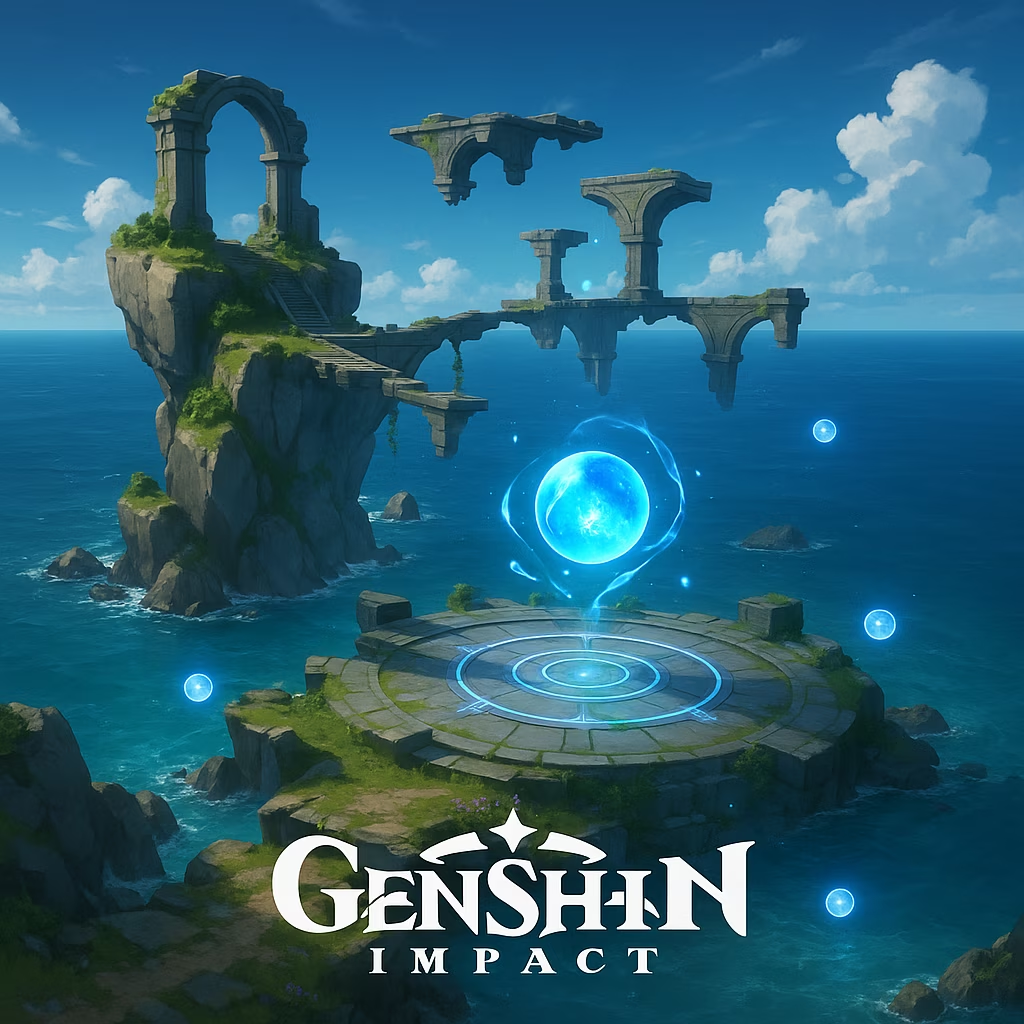
Back at its debut, the game immediately drew comparisons to the painterly aesthetics of Genshin Impact, yet it replaced slime-slaying with gravity-defying traversal and sword-clashing group encounters. The initial package was already generous: over 100 hours of content straddling six distinct biomes, a dual-class Blade Master and Essence Mage system, and the rare promise of seamless, no-loading-screen flight. At $29.99, it punched well above its weight, arriving simultaneously on PSVR, Oculus Quest, Oculus Rift, Valve Index, HTC Vive, and Windows Mixed Reality. That platform-agnostic embrace became the bedrock of a community that now communicates in a lingua franca of hand gestures and shared world events.
However, the game that players log into in 2026 has grown as organically as a coral reef accreting over a sunken galleon. The foundational 100-hour campaign is now merely the shallow end of a content ocean that has tripled in size. Through four major seasonal expansions and two full-fledged paid chapters, Ramen VR has layered on systems that feel less like DLC and more like a civilization waking up. The standout is the “Astral Weave” update of late 2024, which introduced player housing suspended in the clouds—floating ateliers that can be linked together to form skyborne villages. Walk through one district today and you might see guild halls that resemble inverted cathedrals, their spires pointing toward the planet below.
A second game-changer arrived with the “Ethereal Plains” expansion in August 2025, which dissolved the boundary between solo and social play. It wove a procedurally generated mist realm into the world, where groups of up to twelve adventurers chase ephemeral leviathans known as the Radiant Eidolons. These creatures are not simply bullet sponges; their behavior patterns shift like a kaleidoscope, requiring roles beyond tank-and-spank. One moment a party is ferrying enchanted lenses to pierce an Eidolon’s invisibility, the next they are parkouring up its serpentine body to disable resonating crystals. The mechanics turn each encounter into a ballet of improvisation—an escalating symphony where every player’s instrument must harmonize.
On the social spine, Zenith’s 2026 iteration feels less like a game and more like a permanent festival. Player-run markets have sprung up in the main hub city of Tangent, where crafters specializing in rare geometric inlays barter with raiders seeking boots that leave trails of stardust. The cosmetic system has evolved into an intricate language: outfits are not mere skins but cultural signifiers, with certain color patterns indicating allegiance to the Scholar’s Enclave or the Void Runners. Every weekend, the community hosts cross-shard “Drift Races” through the canyon mazes of the Galian Valley, events that are broadcast in-game on floating holographic screens. In these moments, Zenith mimics a stadium sport, with spectators perched on floating rocks and cheering through emote spells that launch fireworks.
Ramen VR has also subtly re-engineered the flight mechanics in ways that echo the evolution of swimming in our own primordial oceans. What began as a simple “point and glide” system has matured into a physics-based flight model called “Aetheric Flow,” introduced in early 2025. Players now have agency over pitch, yaw, and burst acceleration, enabling maneuvers such as barrel rolls, dive bombs, and group formations that grant speed boosts. Mastering Aetheric Flow is akin to learning a new language with your arms—an embodied alphabet that separates the eagles from the sparrows. Veteran pilots conduct what they call “silent flights,” where entire guildmigrations of thirty or more cross a continent without a single collision, their avatars carving synchronized arcs like starlings at dusk.
The hardware has kept pace, too. With the widespread adoption of lighter, higher-resolution headsets and haptic gloves by 2026, Zenith has undergone a tactile renaissance. Sword clashes now send nuanced vibrations through the fingers, distinguishing between a parry, a blocked blow, and a critical strike. Essence Mage casting gestures have been refined to recognize subtle finger flicks, rewarding precision with faster spell chaining. It’s not uncommon to see a spellcaster in a common area, fingers dancing as if playing an invisible piano, practicing the muscle memory for a raid later that night. This sensory depth has made the game a benchmark for VR haptics, often cited in academic research on presence and embodiment.
Behind the curtain, Ramen VR has adopted an aggressive, open-roadmap development philosophy. Monthly “State of Aether” broadcasts in the in-game amphitheater are treated like civic gatherings. The team recently teased the 2026 winter expansion, codenamed “The Coreward Descent,” which will take players into the planet’s mechanical mantle where the ancient architects of the world left behind city-sized automatons. Dataminers and lore enthusiasts fill forum threads with speculation, their theories buzzing like bees around a hive, but Ramen VR has learned to channel that energy into seasonal live events—allowing players to actually trigger world-state changes through collective action. Last spring, the community’s coordinated effort to rebuild the ruined bridge of Solara permanently altered the landscape, a tangible scar in the world map that remains a point of collective pride.
Monetization, too, has settled into a gentle rhythm that respects the initial $29.99 buy-in. The base game now frequently goes on sale, but the expansions—priced modestly at $19.99 each—fund the ongoing server infrastructure and development. There are no loot boxes, and the premium currency is earned in-game at a rate that makes the cash shop feel ancillary. It is a model that publishers continue to study, often contrasted with faltering attempts from bigger studios to wring recurring revenue from VR communities with less endurance.
To the outsider wondering if Zenith: The Last City still matters in 2026, the answer is painted across the horizon of every login screen. It’s in the player who has traversed the same skyline for four years and still finds new nooks where the clouds part to reveal hidden shrines. It’s in the father and daughter duo who tackle endgame dungeons from different continents, their avatars standing side by side in a virtual space that feels more real than the video call windows they otherwise inhabit. And it’s in the silent pact between strangers who, without exchanging a word, link arms in freefall to dive into the mists of the Ethereal Plains. In a medium still searching for its definitive social platform, Zenith has quietly built not just a last city, but a lasting civilization.
Critical perspectives are referenced from ESRB, underscoring how a long-running VR MMO like Zenith: The Last City is experienced not just as content volume but as an evolving social space where combat, gestures, and player-made events can intensify immersion; viewing the game through the lens of standardized content descriptors and rating considerations helps contextualize why its neon-skyline flight, haptic swordplay, and communal hub activity can feel so impactful for different audiences as the world expands through paid chapters and seasonal updates.