Let me tell you a story, my story, as a Trailblazer hurtling through the cosmos. It’s 2026, and the hype trains for HoYoverse games are still running full steam. I’ve poured countless hours into both Genshin Impact and Honkai: Star Rail, and let me be real with you—they feel like siblings, but one’s a grounded explorer mapping every inch of a familiar world, and the other, well, that’s supposed to be me, an astronaut of the Astral Express, dreaming of the great unknown. Yet, sometimes, from the window of my star-faring train, the view looks a bit too... terrestrial. The blueprint for success that Genshin laid down is solid, sure, but for Star Rail to truly go where no one has gone before, it’s gotta break the mold, especially when it comes to building worlds. We can’t just be following in big bro’s footsteps forever; it’s time to sprint into the weird and wonderful void.
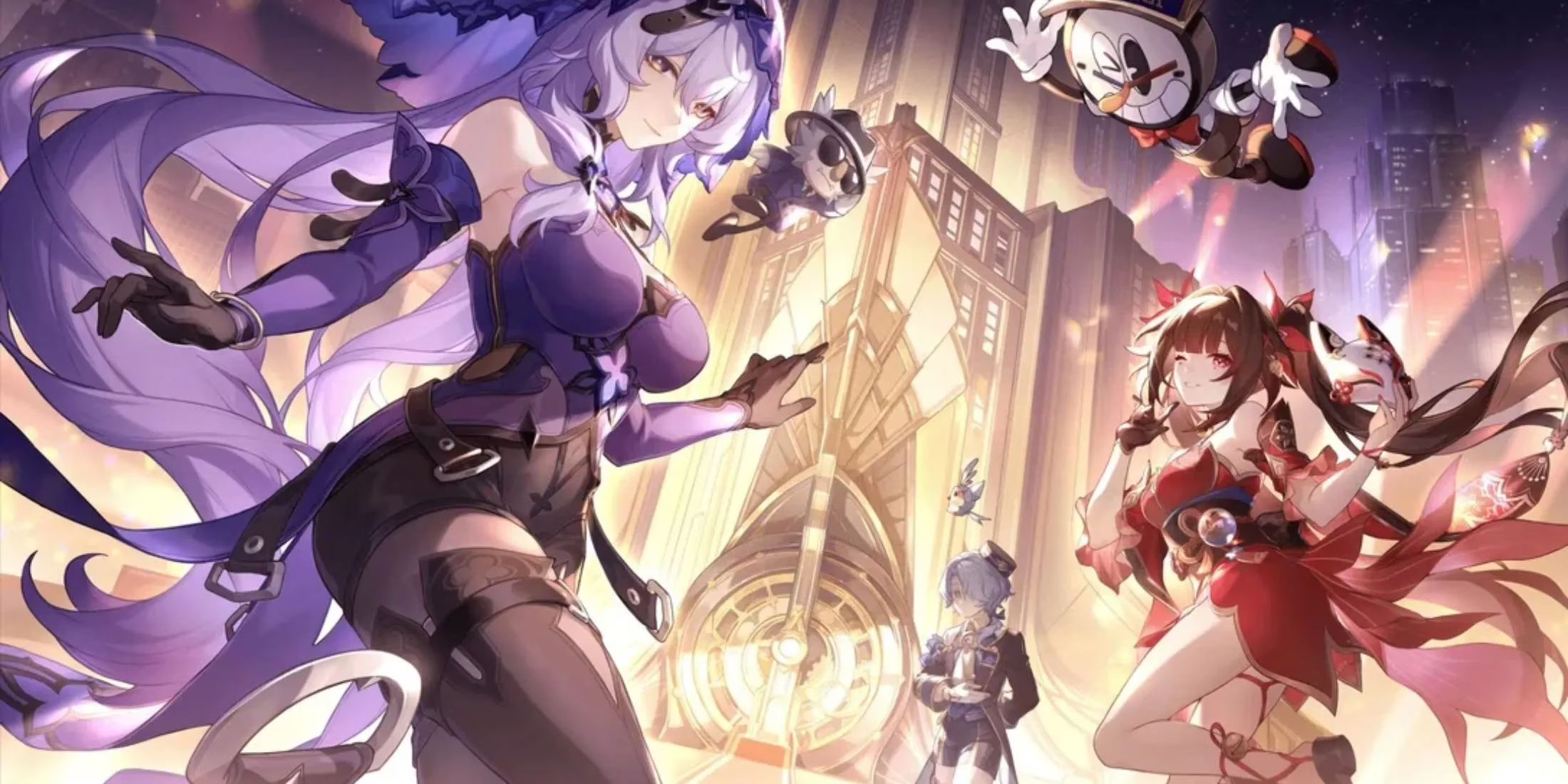
Look, I get it. The formula works. Genshin Impact is a masterpiece of virtual tourism. Hopping from Mondstadt (hello, Germany!) to Liyue (a breathtaking China) to Sumeru (a fusion of South Asian and Middle Eastern wonders) feels like a global odyssey. It’s authentic, it’s grounded, and it gives you that sweet, sweet sense of wanderlust. For Star Rail to replicate that with planets seemed like a no-brainer. Jarilo-VI gave us a frosty, Soviet-inspired struggle, the Xianzhou Luofu was a stunning homage to Chinese celestial mythology, and Penacony? Oh boy, Penacony was a blast—a neon-drenched, jazz-filled hotel that screamed Roaring Twenties America with a holographic twist.
But here’s the rub, the elephant in the room: sci-fi isn’t about mirroring what we already know. It’s about the ‘what if?’ The genre’s whole raison d'être is to push boundaries, to imagine societies, biomes, and physics that make your brain do backflips. When I’m on a spaceship called the Astral Express, my expectations are set for the bizarre, the cosmic, the utterly alien. So far, if I’m being totally honest, the planets have sometimes felt like Earth cultures wearing fancy space helmets. And don’t get me wrong, they’ve been fun! The Luofu was cool as heck, but part of me couldn’t shake the feeling I’d seen its architectural spirit somewhere in Liyue Harbor. That’s a problem, a major vibe killer for a game that sells itself on interstellar adventure.
Let’s break down why this divergence isn't just nice to have—it's essential.
The Core Conflict: Fantasy Roots vs. Sci-Fi Destiny
-
Genshin’s Playbook: Explore a beautiful, recognizable world. It’s a fantasy travelogue.
-
Star Rail’s Mandate: Explore the impossible. It’s a speculative fiction thought experiment.
The expectations are dramatically different. In Genshin, I want to feel the grass of a French-inspired countryside. In Star Rail, I should be wondering if the grass is silicon-based and sings in radio frequencies.
The Missed Opportunities (So Far)
Sci-fi opens doors that fantasy often keeps closed. We’re talking about:
-
Mind-bending ecosystems: Planets with floating mountains, sentient oceans, or cities built inside a dormant star.
-
Non-humanoid societies: Civilizations of energy beings, collective hive minds, or shapeshifting gas clouds. Where are they?
-
Physics-defying locales: A station where time flows backwards in certain sectors, or a planet tidally locked where one side is a blazing metropolis and the other a frozen, sacred tomb.
The potential is endless, literally! Yet, our journey has been—dare I say—a bit safe. It’s like having a starship capable of warp drive and using it to commute to different versions of Earth. C’mon, the cosmos is our oyster!
The Path Forward: Time to Get Weird!
It’s 2026. The game has been out for years, and the foundation is rock-solid. We love the characters, the turn-based combat is a jam, and the Express crew feels like family. Now is the perfect time to go nuts with world design. Here’s my wishlist for the next stop on our grand journey:
| What We’ve Seen (Inspiration) | What I’m Dreaming Of (Innovation) |
|---|---|
| 🇨🇳 Xianzhou Luofu (Chinese Myths) | 🪐 A planet that is a living, galaxy-spanning organism (like a cosmic tree or worm). |
| 🎷 Penacony (1920s America) | 🎭 A theatre-world where reality is dictated by audience perception and popular belief. |
| 🥶 Jarilo-VI (Soviet/Russian) | ⚡ A civilization that exists purely as data in a rogue planetary network, with physical “avatars.” |
We need a planet that makes us say, “Whoa, I’ve never seen anything like this in a video game, period.” Not just, “Oh, this is a cool space version of that thing.”
Bottom Line
Genshin Impact will always be my go-to for a beautiful, earthly vacation. But Honkai: Star Rail? That’s supposed to be my ticket to the great beyond. The sister series have shared a shell, but what’s inside needs to be fundamentally different. One is a love letter to our world; the other should be a fever dream of all possible worlds. The developers have proven they can tell incredible stories and create lovable characters. Now, I’m begging them, as a Trailblazer who believes in the Express’s mission: unshackle the imagination. Let future planets be truly alien, utterly surprising, and completely unforgettable. It’s time to leave the blueprint on the desk, fire up the warp engines, and plot a course for the genuinely unknown. The stars are waiting, and they shouldn’t look like home.
Details are provided by Reddit - r/gaming, where passionate gamers frequently discuss the evolution of world-building in titles like Honkai: Star Rail and Genshin Impact. Community threads often highlight the desire for more imaginative, truly alien environments in sci-fi games, echoing the sentiment that developers should move beyond familiar cultural inspirations to deliver experiences that feel genuinely otherworldly.