Six years in, Genshin Impact is still one of those games people argue about for good reason, and the big question hasn’t really changed: is Genshin Impact good enough to be worth your time in 2026? The short answer is yes, pretty clearly — but it comes with some real caveats, and those caveats matter a lot depending on what kind of player you are. With more than 300 million registered accounts, over $10 billion in lifetime player spending by the end of 2025, and Version Luna VI pushing Mondstadt northward with Dornman Port and the Temple of Space, HoYoverse is very obviously not slowing down. This review is here to help new players, returning players, and anyone just curious figure out whether jumping in actually makes sense.
Is Genshin Impact Good in 2026?
The simple verdict is this: Genshin Impact is still an excellent free-to-play open-world action RPG, and it earns that reputation through strong combat systems, constant content updates, and some of the best art direction in the genre. It’s especially good for players who like elemental reaction theory-crafting, exploring large regions with actual story context, and a daily routine that usually asks for only 30 to 60 minutes of focused time. On the flip side, if you hate gacha on principle, get burned out by repetitive artifact farming, or want a fast, linear progression curve like a premium single-player RPG, this probably won’t be your game.
| Player Type | Verdict | Reasoning |
|---|---|---|
| Story + Exploration fan | Strong Yes | Years of voiced narrative, culturally distinct regions |
| Team-building enthusiast | Yes | Deep elemental reaction system, rotating meta |
| Casual F2P | Yes | Generous daily income, no pay-to-win gating for story |
| Competitive min-maxer | Conditional | Artifact RNG can be deeply frustrating |
| Gacha-averse player | No | Character acquisition is inherently gacha-dependent |
| Returning player (lapsed) | Yes | QoL improvements, story archive, catch-up systems |
For context, Version Luna VI matters a lot here. The April 2026 patch added Dornman Port, a busy northern Mondstadt trade city built around momentum-based traversal, plus the strange Temple of Space, where players uncover fragments connected to Asmoday, the sovereign of sky and space. It also introduced the new five-star Linnea, a Geo Bow support who turns Hydro-Crystallize into Lunar-Crystallize. That update pretty much sums up HoYoverse’s current formula: take familiar parts of the world, then refresh them with new mechanics and stronger narrative payoff.
Genshin Impact Gameplay Quality
At its core, Genshin’s gameplay loop still holds up surprisingly well in year six. Roughly every six weeks, a new patch brings story updates, fresh characters, limited events, and small but meaningful quality-of-life changes, so even if you skip a couple of weeks, there’s usually something new waiting when you log back in. The daily loop is also pretty light compared to a lot of live-service games: four commissions, spending resin, and maybe clearing some event tasks covers most of what feels “mandatory.” Everything beyond that is optional, and that’s where the game is usually at its best — hidden chests, layered puzzles, and bits of lore tucked all over the map.
Story pacing has also gotten noticeably better through the 6.x cycle. The Nod-Krai arc and the Luna VI follow-up land much better for players who’ve stayed invested in the Traveler and sibling storyline over the long haul. Cutscenes now feel more cinematic than a lot of the early-game material, and the archive system is a genuinely useful addition since it lets returning players revisit story content they missed instead of just piecing things together from memory.
Combat and Team Building
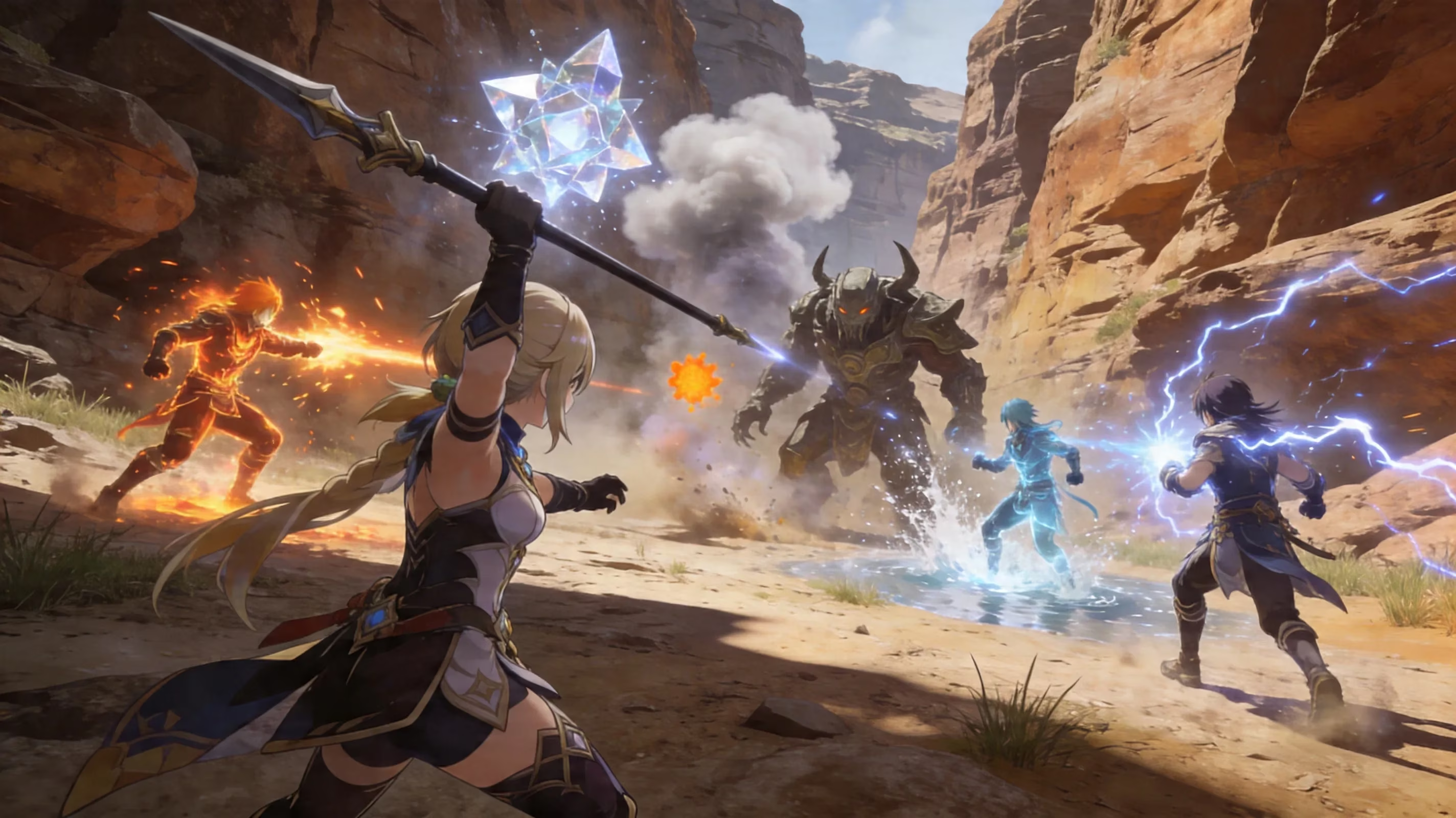
The elemental reaction system is still the heart of the game, and honestly, it remains one of the most mechanically interesting combat systems in the gacha space. You’re juggling hidden elemental gauge timing, off-field skill uptime, and swap rotations all at once. Add in dash i-frames, burst timing during boss windows, and four-character team construction built around reaction synergy, and there’s real depth here beyond just pressing cooldowns.
Version 6.0’s Lunar-Crystallize mechanic gave Crystallize teams a new defensive shockwave utility, which is a big deal because it encouraged fresh team-building instead of pushing everyone back into the same old hypercarry shells. Newer characters have also helped shake things up. Varka, for example, changes how physical scaling works by sidestepping the usual Superconduct reliance through built-in physical resistance shred, while Linnea gives Geo support teams a much stronger reason to exist than they had before. If you want to test those setups, the two main endgame checks are still the Spiral Abyss and Imaginarium Theater. Abyss wants two optimized teams that can hit strict DPS checks against rotating enemy waves, while Theater leans more roguelike and punishes narrow rosters, rewarding players who’ve built wide instead of tall.
Open World and Exploration
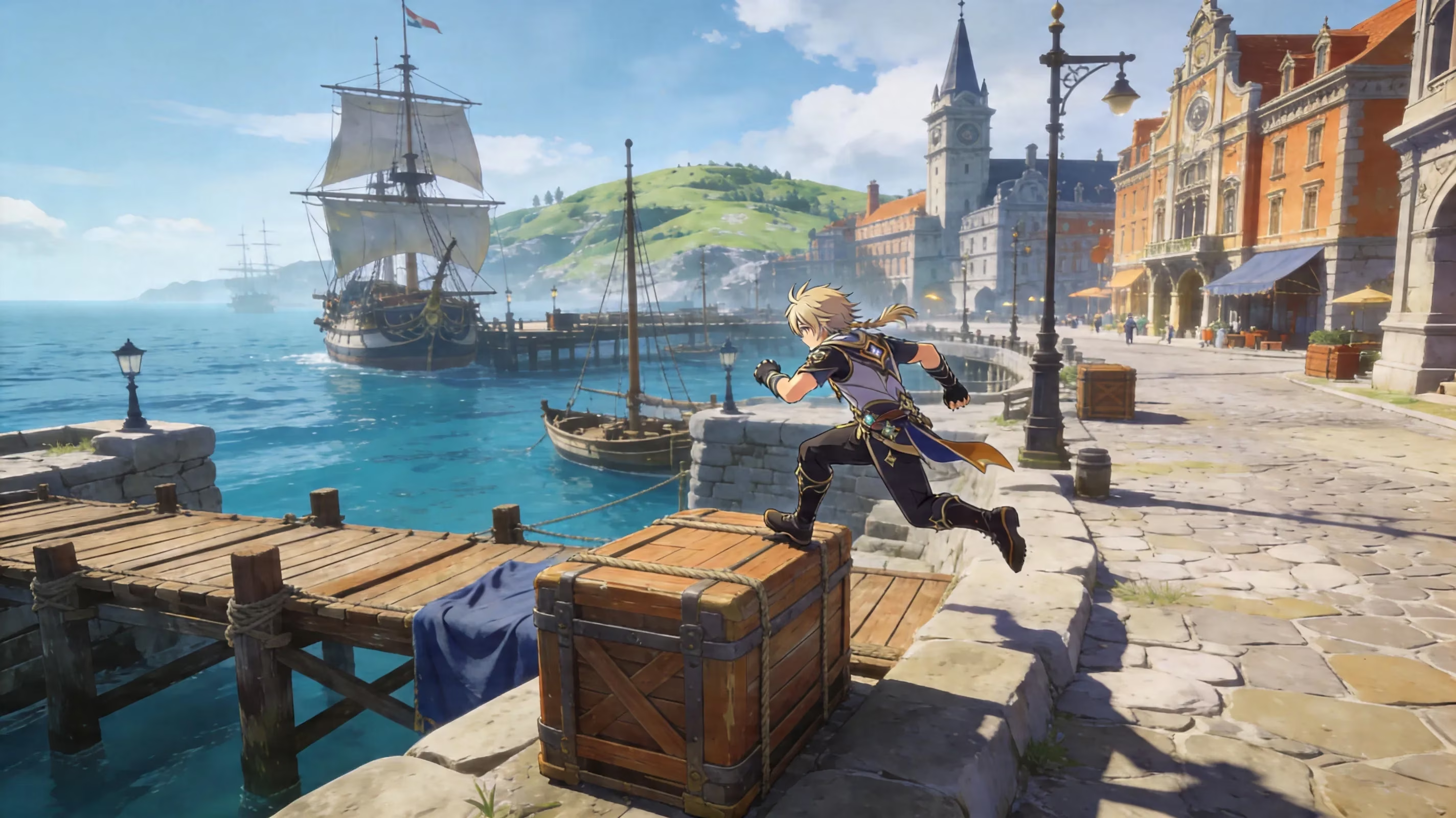
Dornman Port is probably the clearest sign that Genshin’s open world still knows how to evolve. In that area, localized grappling hooks and momentum-based gliding rings replace the usual movement flow, and that makes exploration feel way more dynamic than the standard climb-and-stamina routine. The Temple of Space helps too, offering a vertical, puzzle-heavy dungeon with realm-shifting mechanics that echo older regions like Liyue and Sumeru while still feeling distinct.
That said, some long-running frustrations are still here. The stamina wheel is somehow still capped where it was back in 1.0, despite years of complaints. Running out of stamina halfway up a cliff and dropping all the way down is just as annoying now as it was at launch. Some puzzles still force awkward party swaps to trigger elemental mechanisms, which breaks your momentum and feels dated compared to newer competitors. And in the latest regions, map density can sometimes tip too far toward “stuff to clear” instead of natural discovery, which makes full exploration feel a bit checklist-heavy.
Genshin Impact Monetization Value
The monetization is absolutely designed to push spending, but it’s manageable if you’re disciplined. If you’re trying to decide whether is Genshin Impact good value at your spending level, you really need to understand how the pull economy works in practice, not just in theory.
The Blessing of the Welkin Moon is still the best low-spend purchase by a mile. For $5 a month, you get 300 Genesis Crystals upfront and 90 Primogems per day for 30 days, which adds up to 2,700 Primogems total and about 18 Intertwined Fates over a full month of logging in. Buying 3,000 Genesis Crystals directly costs $50, so Welkin is dramatically more efficient. The Battle Pass, priced at $10 per six-week patch, adds 680 Primogems along with Fragile Resin, talent materials, and exclusive craftable weapons like Deathmatch and Ballads of the Fjords. If you’re a low spender, it gives much better account value than just buying raw currency.
The weapon banner, meanwhile, is still the classic trap. Even after the Fate Points adjustments, getting one specific five-star signature weapon can still take as many as 240 pulls if you lose twice before the guarantee kicks in. Realistically, most players should treat the weapon banner as off-limits unless they already have their target character secured and enough spare currency to absorb the worst-case outcome.
Pull Economy
The limited character banner still runs on the familiar 50/50 system with a hard pity at 90 pulls. Soft pity usually starts around pull 74, where your five-star odds begin climbing with each pull after that. If you lose the 50/50, your next five-star is guaranteed to be the featured unit, and that guarantee carries across banner phases within the same version. A fully active F2P player can usually earn around 5,500 to 8,000 Primogems per month through daily commissions (1,800 monthly), Spiral Abyss resets every two weeks (up to 1,200 monthly with full 36-star clears), limited events (roughly 1,500 to 4,000 depending on the patch), and HoYoLAB check-ins.
The problem is banner pacing. The 6.x schedule has been aggressive, and multiple high-value limited characters often land close together, which creates real FOMO pressure even if you’re normally careful with your savings. If you want a debut character, you should budget around 14,400 Primogems for 90 pulls if you’re entering on a fresh 50/50, or 28,800 if you need the full guarantee after a loss. For low spenders running Welkin and clearing events consistently, one guaranteed limited five-star per patch cycle is a realistic expectation.
Is Genshin Impact Good for New Players?
Starting Genshin in 2026 means stepping into a huge game: more than five years of built-up content, seven major nations, around 100 playable characters, and a massive pile of story quests, world quests, and domains. The onboarding is better than it used to be, but it’s still front-loaded. Adventure Rank gates a lot of systems — artifact farming, domains, co-op, even the Battle Pass — so your first couple of weeks are mostly about exploration and story progression rather than the deeper team-building that defines the late game.
The good news is that the floor for account power is much friendlier now than it was in the early years. A free roster using units like Xiangling, Barbara, and the Traveler, plus solid four-stars picked up from banners and events, can absolutely clear Spiral Abyss and Imaginarium Theater if you invest properly into artifacts. Performance is also in a good spot across platforms. PS5 and Xbox Series X|S hold a stable 60 FPS even in heavier combat scenarios, and the mobile version handles the asset load reasonably well, with platform data showing average session lengths around 118 minutes.
New and Returning Accounts
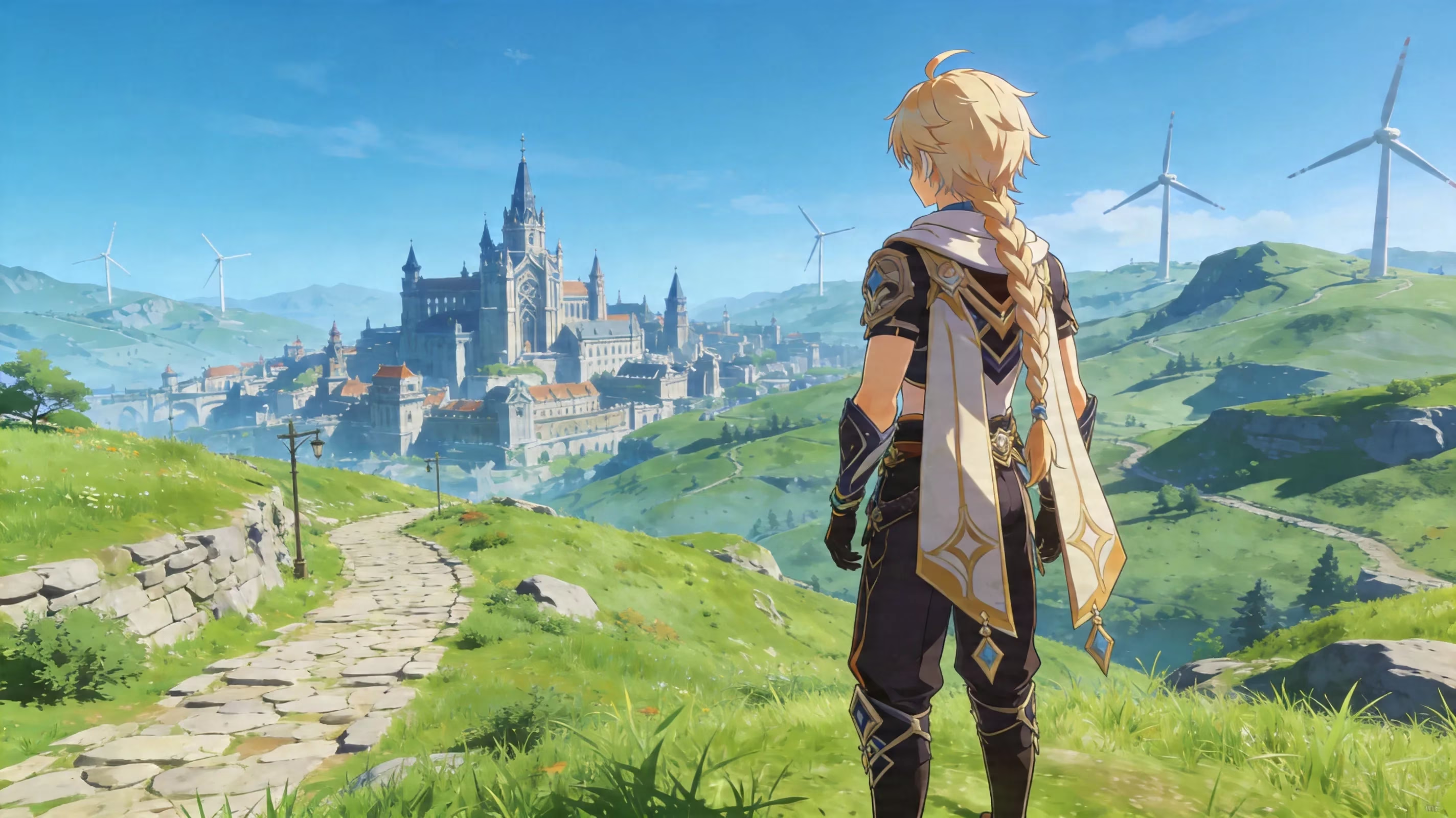
For new and returning players, the story backlog creates different kinds of friction. A fresh account is looking at months of content if you want to move through the narrative at a natural pace. The game doesn’t force you to finish every older chapter before entering newer regions, which helps, but later story moments definitely hit harder if you’ve seen the setup. Returning players who stopped around Fontaine or earlier will notice a much smoother experience right away thanks to the quest archive, cleaner build-planning tools, and the artifact strongbox conversion system.
One issue still hurts both groups: old limited-time events are gone for good. Some event mechanics eventually get folded into permanent modes — the Version 5.3 rhythm game is a good example — but the original event stories and cosmetic rewards are still unrecoverable. That’s one of the game’s most frustrating structural flaws, and it doesn’t really matter whether you’re brand new or coming back after a long break.
Genshin Impact Pros and Cons
The biggest reasons to play in 2026 are pretty easy to spot:
-
Elemental combat still feels excellent: The reaction system has real depth, and the controls remain responsive.
-
The world keeps expanding in meaningful ways: New regions are visually distinct and usually bring fresh traversal ideas.
-
F2P income is better than many rival gachas: You can build a strong account without paying, as long as you manage resources well.
-
The long-form narrative actually pays off: If you stick with it, the story gives you genuine payoff instead of endless setup.
-
Production quality is absurdly high: Dynamic cloth physics, reactive lighting in Dornman Port’s snowfields, and a 1,490-track orchestral soundtrack put most free-to-play games to shame.
The biggest pain points are just as clear:
-
Artifact RNG is brutal: Build progress can stall for weeks because too many random layers stack on top of each other.
-
Traversal friction never fully went away: The stamina cap still feels outdated.
-
Auto-targeting can be messy: In crowded fights, the camera still loves locking onto the wrong enemy.
-
Visual clutter is a real issue: Heavy reaction teams can make it hard to read enemy attack animations when it matters most.
Compared with Wuthering Waves, Genshin gives up some mobility, dodge-cancel freedom, and raw action-game speed in exchange for stronger world-building, a longer narrative runway, and a steadier content cadence. Compared with Honkai: Star Rail, Genshin offers a much richer exploration experience, but it also asks more from you mechanically because everything happens in real time. So when people ask whether is Genshin Impact good, the answer really depends on what you value most.
| Account Type | Recommendation |
|---|---|
| Brand new player, exploration focus | Play — rich world with years of content |
| Returning player, 1+ year lapse | Return — QoL improvements justify re-entry |
| Gacha veteran, team-building focus | Play — reaction depth rivals any genre peer |
| Time-limited casual player | Conditional — daily loop is light, but events create pressure |
| Whale or high spender | Play — roster breadth enables all endgame modes comfortably |
| F2P completionist | Conditional — requires disciplined resource management |
Conclusion
So, is Genshin Impact good in 2026? Yes — for most players, it absolutely is. Its elemental combat still outclasses a lot of modern action RPGs in terms of depth, the world remains one of the strongest in free-to-play gaming, and the six-week patch cycle keeps the experience feeling alive. If you like exploration-heavy RPGs, story-driven progression, and team-building with actual theory-craft behind it, Genshin is still an easy recommendation.
Still, the downsides are real. Artifact farming is an RNG treadmill that can waste a lot of your time. The gacha model is rough on impulsive spenders. Stamina friction and auto-targeting problems are still hanging around after years of player feedback. If those were the exact reasons you quit before, don’t expect a miracle fix.
If you’re unsure, the best move is honestly simple: download it, play through Mondstadt and Liyue at your own pace, and give the elemental system enough time to click before you decide. Teyvat still has hundreds of hours of content, a long-running story that’s still building toward its endgame, and a dev team that keeps expanding the game in meaningful ways. For the right kind of player, that’s more than enough reason to jump in.