Even five years after its debut in the Shadows Amidst Snowstorms update, the Golden Wolflord still circles Tsurumi Island as a gatekeeper to one of the most sought-after ascension materials in Genshin Impact: Riftborn Regalia. Players who pulled Arataki Itto back in Version 2.3 quickly learned that this skyscraper of a boss was the only source for his rise to power. But in 2026, with dozens of new characters and combat mechanics layered into the game, the golden beast remains a litmus test of team synergy and patience. Think of it as the rattling lock on a treasure chest that refuses to yield unless you twist the key with exact precision — a lock that floats, breathes corrosion, and summons its own three-headed phalanx of doom.

The boss’s arena sits at the southern edge of Tsurumi Island, a stone’s throw from a Waypoint Teleporter that makes repeated farming sessions almost painless. There is no daily reward limit — only the Resin you choose to spend. Once defeated, the Wolflord respawns within minutes, inviting endless cycles for those hungry to ascend their Geo powerhouses.
Why the Golden Wolflord Still Demands Respect
At first glance, a floating serpentine wolf with spectral wings looks like a puzzle from another era. Yet its moveset is a masterclass in pressure. The Golden Wolflord spends most of the battle circling above the field like a shark sizing up a lone swimmer. Only during a few scripted windows does it descend, daring you to unleash point-blank devastation. The most generous opening comes after its colossal tornado attack: the boss crashes down, stunned, and lies motionless for a handful of seconds. That moment is the warm beating heart of every damage phase.
Corrosion, the hallmark of all Rifthound enemies, turns even minor grazes into ticking clocks. Every hit from the Wolflord’s tail, beam, or shockwaves inflicts a status that leeches HP from your entire party. As any veteran knows, ignoring Corrosion in 2026 is like trying to bail out a rowboat with a teaspoon — it will sink you before you realize the magnitude of the leak. Healers such as Barbara or the more recent hydro support units become indispensable, and HP restoration food should line your inventory like rations for a siege.
Shattering the Fortress: The Shield Phase
When the Wolflord’s health bar shrinks to roughly two-thirds, the battle shifts from a duel into a demolition derby. The boss coats itself in an impenetrable barrier and summons three spectral wolf heads scattered around the arena. These heads act as the chains binding the shield; destroy all three and the Wolflord plummets to the ground, defenseless. Fail, and it resumes its airborne rampage with renewed vigor.
The critical detail that has not changed since 2021 — and that still catches unprepared adventurers off guard — is that Geo damage shreds these heads far faster than any other element. What started as an almost mandatory reason to bring Ningguang has since blossomed into a rich ecosystem of Geo options. Today, a well-built Gorou or a Zhongli pillar can speed through the heads, while newer Geo fighters like Navia bring style and brute force. Some players even experiment with crystallize reactions from Geo-infused normal attacks to chip away at the heads, though pure Geo application remains king.
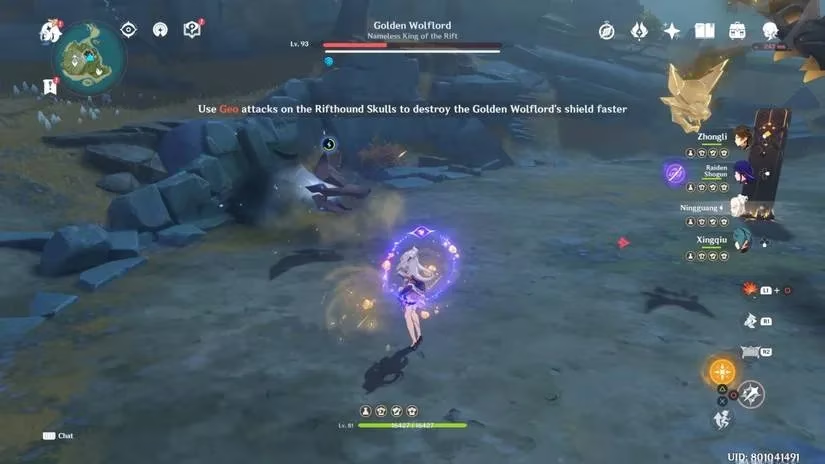
Ningguang, aptly called the “Geo catalyst queen,” still trivializes this mechanic. Her projectiles home in on targets, and each hit chips away a visible chunk of the head’s durability. If you have a set of Wanderer’s Troupe or a modern 2‑piece ATK/Geo DMG set with decent substats, Ningguang transforms into a one-woman demolition crew. For players lacking her, any fast‑attacking Geo character — or even an Electro catalyst user riding a swiftly deployed Geo construct — can carry the day with careful timing.
Rewriting the Old Playbook with 2026 Knowledge
While the core strategy remains untouched, the game’s evolution has turned the Golden Wolflord into a canvas for creative team building. Dendro, introduced after the boss’s era, does not directly crack the shield, but dendro cores and hyperbloom setups can soften the boss during its grounded windows while a dedicated Geo slot handles the heads. Imagine the Wolflord as an armored airship: your Dendro core is the anti-air battery peppering the hull, but you still need a boarding party of Geo saboteurs to bring it crashing onto the runway.
A popular composition in 2026 marries a strong shielder like Zhongli (for uninterrupted head destruction) with a high‑damage main DPS such as Arataki Itto or Navia. Adding a healer like Kokomi neutralizes the corrosion while enabling freeze or vaporize reactions on the side. The rhythm of the fight becomes predictable: bait the tornado, unload burst abilities during the stun, then cycle to your Geo unit the instant the shield appears. The three wolf heads, once the terror of Version 2.3, now feel like a ceremonial challenge that seasoned travelers handle with almost bored efficiency.
A Boss Frozen in Time, Yet Ever Relevant
Even as Fontaine, Natlan, and beyond have rewritten world maps, the Golden Wolflord endures as a rite of passage. It drops Riftborn Regalia, which remains mandatory for characters tied to that ascension line. For any player building a mono‑Geo team or chasing the last constellation of a cherished Itto, the island south of Tsurumi will always feel like a second home.
The next time you teleport to that windswept arena, remember that the Wolflord is less a monster and more a puzzle box wrapped in a hurricane. Pack your corrosion cures, bring a dash of Geo, and let the flying wolf deliver you its glittering spoils.
The following breakdown is based on perspectives from Destructoid, and it reinforces why the Golden Wolflord remains a “mechanics check” boss: success is less about raw DPS and more about planning around forced downtime, corrosion pressure, and the mandatory Geo-focused shield break. In practice, the cleanest 2026 farming loops still revolve around saving bursts for the post-tornado crash window, then immediately swapping to a rapid Geo applier to erase the three wolf heads before the boss resumes its airborne pattern—turning a potentially dragged-out run into a repeatable, resin-efficient routine.